


Views: 0 Author: Site Editor Publish Time: 2026-09-15 Origin: Site


The field efficacy of any glue-based trap or monitor is fundamentally limited by the chemical and physical properties of its adhesive formulation. Manufacturers face a rigorous balancing act on the production floor. You must deliver extreme, long-lasting surface tack to secure pests while maintaining high-speed production lines, environmental stability, and strict regulatory safety. Trap failure directly damages brand reputation, making adhesive selection a critical engineering decision.
We evaluate why hot melt formulations have become the industry standard over solvent-based or water-based alternatives. This analysis covers production efficiency, safety profiles, and application-specific performance metrics. Understanding the underlying chemistry and mechanical properties of these adhesives allows production managers to optimize assembly lines and improve capture rates in the field. Selecting the right pest control hot melt adhesive dictates the success of the final product.
100% Solid Formulation: Hot melt adhesives eliminate volatile organic compounds (VOCs) and hazardous solvents, ensuring compliance and safety in sensitive environments (e.g., food processing, residential).
Production Efficiency: Fast set times and clean-running properties (minimal stringing) enable high-speed automated assembly without the extended drying times required by water-based glues.
Application-Specific Tack: Formulations can be engineered for precise open times and tack levels, differentiating between the shear strength needed for rodents and the UV stability required for flying insects.
Scalable Customization: Partnering with a specialized pest control adhesive manufacturer allows for custom viscosity and softening points tailored to specific geographic climates and proprietary trap designs.
Defining success for a pest control adhesive requires measuring specific mechanical forces. Trap failure occurs when an adhesive lacks the correct balance of initial grab and long-term holding power. Engineers evaluate formulations based on four critical metrics.
Initial Tack (Grab): The adhesive must instantly bond to the pest upon the lightest physical contact. Insects and rodents move quickly. The glue must wet out on scales, fur, or exoskeletons in milliseconds.
Peel Strength: This measures the force required to pull the pest away from the adhesive surface at an angle. High peel strength prevents pests from leveraging their body weight to tear free.
Shear Resistance: Shear measures the adhesive's ability to withstand lateral, sliding forces. When a heavy rodent attempts to drag itself across the trap, high shear resistance keeps the adhesive matrix intact.
Long-Term Open Time: Unlike packaging glues that cure and harden, trap adhesives must remain permanently tacky. They must resist skinning over, oxidizing, or drying out over several months of deployment.
To quantify these metrics, quality control laboratories execute standardized testing protocols before approving any batch for production. These tests ensure the adhesive performs predictably under field conditions.
Rolling Ball Tack Test (ASTM D3121): Measures the initial grab by rolling a steel ball down an incline onto the adhesive surface. A shorter travel distance indicates higher surface tack.
180-Degree Peel Adhesion (ASTM D3330): Quantifies the force required to peel a standardized strip from a stainless steel plate, indicating the adhesive's bond strength.
Static Shear Testing (ASTM D3654): Hangs a specific weight from an adhesive strip applied to a vertical panel. This measures the cohesive strength and resistance to cold flow over time.
Accelerated Aging: Subjects the adhesive to elevated temperatures and UV exposure in environmental chambers to simulate months of field deployment in a matter of days.
Legacy adhesive technologies present significant operational hurdles on the factory floor. Solvent-based glues rely on volatile chemicals to keep the adhesive liquid. As the solvent evaporates, the glue becomes tacky. However, solvents introduce severe flammability risks. Facilities require explosion-proof electrical fixtures, specialized ventilation systems, and strict hazardous waste disposal protocols. Solvent off-gassing also leaves residual odors that deter sensitive pests from approaching the trap.
Water-based adhesives eliminate the flammability risk but introduce massive production bottlenecks. They require energy-intensive drying ovens to evaporate the water carrier. A typical drying tunnel can consume fifty feet of floor space and draw massive amounts of electricity. Water-based glues also struggle with immediate adhesion consistency. High ambient humidity in the manufacturing facility drastically alters drying times. This leads to inconsistent coat weights, paper curling on cardboard substrates, and compromised trap performance.
Hot melt technology bypasses these limitations entirely. Delivered as a 100% solid thermoplastic, it melts upon heating and regains its structural integrity immediately upon cooling. You eliminate both the hazardous fumes of solvents and the thermal bottlenecks of water-based systems. The small footprint of hot melt extrusion equipment frees up valuable factory floor space.
The core technology behind modern traps is the Hot Melt Pressure-Sensitive Adhesive (HMPSA). These formulations rely on a precise blend of three primary chemical components to maintain permanent room-temperature tack.
Thermoplastic Elastomers: Polymers like Styrene-Isoprene-Styrene (SIS) or Styrene-Butadiene-Styrene (SBS) form the structural backbone. They provide the rubber-like elasticity and cohesive strength necessary to hold struggling pests.
Tackifying Resins: Derived from rosin esters or hydrocarbon resins, these additives dictate the stickiness of the formulation. They lower the polymer's surface energy, allowing it to flow into the microscopic crevices of a pest's body.
Plasticizers: Typically naphthenic or paraffinic mineral oils, plasticizers soften the adhesive matrix. They lower the glass transition temperature (Tg), ensuring the glue remains flexible and tacky rather than turning brittle in cold environments.
By adjusting the ratios of these components, chemists engineer the adhesive to meet exact environmental demands. The choice of base polymer heavily influences the final performance characteristics.
Polymer Base | Primary Characteristics | Best Suited For |
|---|---|---|
Styrene-Isoprene-Styrene (SIS) | Exceptional initial tack, high elasticity, lower shear strength. | Lightweight insects, fly traps, cockroach monitors. |
Styrene-Butadiene-Styrene (SBS) | Higher cohesive strength, excellent shear resistance, lower initial tack. | Heavy rodents, rats, mice, industrial environments. |
Manufacturing a complete pest control product often requires two distinct types of hot melt adhesive working in tandem. The capture surface utilizes permanently tacky HMPSAs designed exclusively for trapping. These formulations never fully set. They remain fluid enough to wet out on contact but cohesive enough to prevent the pest from escaping.
Conversely, the physical construction of the trap relies on standard structural hot melts. Manufacturers use fast-setting Ethylene-Vinyl Acetate (EVA) or metallocene-based glues to secure bait blocks to the trap base. You also use them to attach plastic lids, assemble cardboard housings, and seal the final retail packaging. Structural hot melts cure rapidly to form a rigid, permanent bond. This ensures the trap housing withstands rough transit and deployment without falling apart.
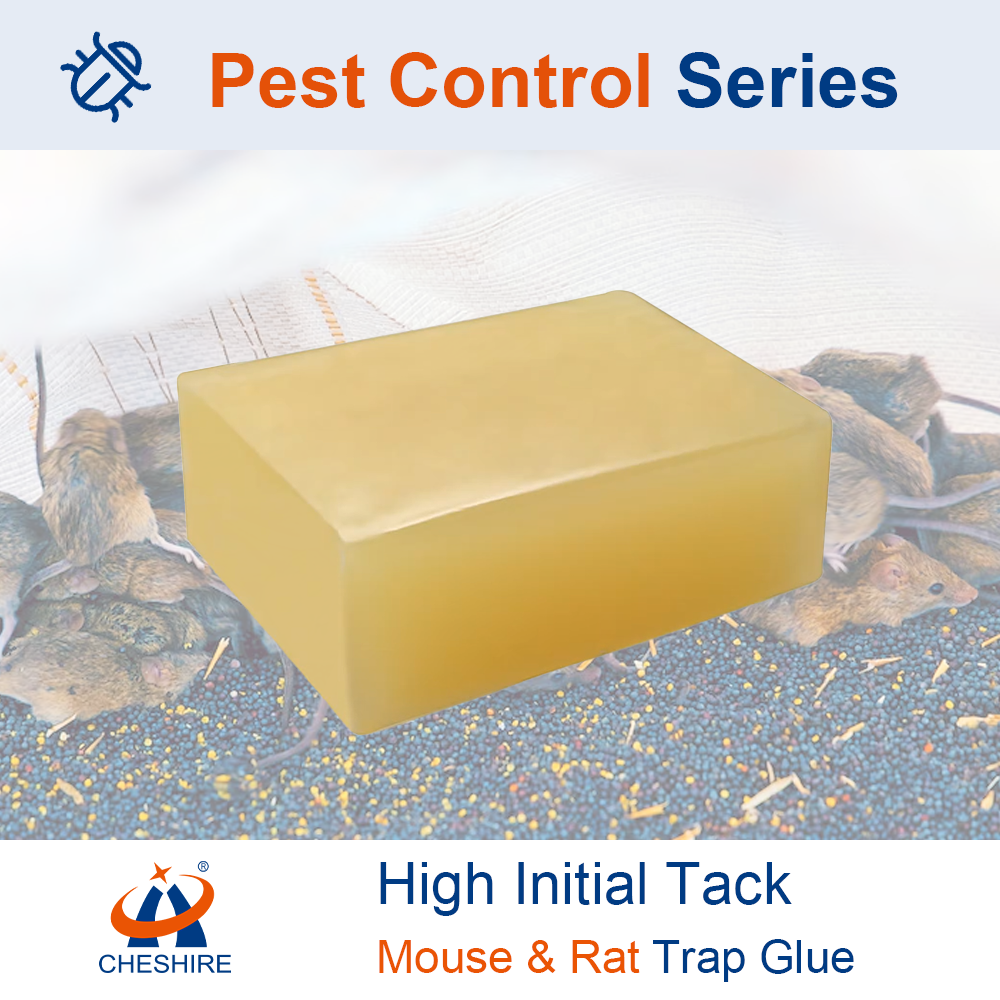
Rodent control demands the most robust mechanical properties of any trap adhesive. Rats and mice possess significant muscle mass and exert extreme lateral force to escape. Mouse rat trap hot melt glue requires exceptionally high shear strength. If the cohesive strength of the glue is too low, the adhesive stretches and snaps. The rodent pulls free, leaving only a patch of glue behind.
Manufacturers apply heavy coat weights, typically ranging from 150 to 300 grams per square meter (gsm), to ensure the adhesive mass engulfs the rodent's fur and limbs. Environmental factors dictate the formulation strategy. Rodent traps frequently deploy in unheated warehouses, basements, or agricultural facilities during winter. The adhesive must maintain a low glass transition temperature. If the glue freezes or turns glassy at sub-zero temperatures, it loses all surface tack. Engineers formulate cold-weather rodent glues with higher plasticizer loads to maintain flexibility in freezing conditions.
Flying insect traps operate under entirely different physical and environmental constraints. Fly trap hot melt glue prioritizes immediate, aggressive surface tack. Flies exert very little physical force, but they make only brief, light contact with the trap surface. The adhesive must grab instantly before the insect can push off and fly away.
Because fly traps often hang vertically or mount overhead, the adhesive requires high cohesive strength to prevent dripping or sagging. A formulation that flows too easily will run off the substrate in warm environments, creating a mess and ruining the trap. Environmental degradation poses the biggest threat. Fly ribbons and boards frequently sit in direct sunlight or mount directly adjacent to high-intensity UV attractant bulbs. Standard adhesives quickly oxidize, turn yellow, and develop a hard, non-tacky skin when exposed to continuous UV radiation. Fly trap formulations require heavy doses of hindered amine light stabilizers (HALS) and antioxidants to maintain their open time under harsh lighting.
Crawling insect monitors face severe micro-climate challenges. Cockroach trap hot melt glue must perform reliably in damp, dark environments like commercial kitchens, under sinks, and inside plumbing voids. Moisture resistance is non-negotiable. If the adhesive absorbs ambient humidity, it loses its tack and fails to secure the insect. Formulators use hydrophobic hydrocarbon resins to repel water and maintain surface energy.
Dust tolerance represents another critical formulation factor. Floor-level traps accumulate ambient dust, flour, and debris rapidly. The adhesive must possess enough fluid volume to absorb light dust while maintaining active surface area for capturing pests. Manufacturers typically use lower coat weights for cockroach traps, around 40 to 80 gsm. They rely on a highly plasticized, flowable formulation to ensnare lightweight exoskeletons without wasting excess material.
Target Pest | Core Mechanical Requirement | Primary Environmental Challenge | Formulation Focus |
|---|---|---|---|
Rodents (Mice/Rats) | Extreme shear strength and high coat weight (150-300+ gsm) | Cold temperatures (unheated storage) | Low Tg, high cohesive strength SBS elastomer blend |
Flying Insects | Instant surface grab (tack) and zero drip | Continuous UV exposure and vertical hanging | UV stabilizers, high temperature sag resistance, SIS blend |
Crawling Insects | Moisture resistance and dust tolerance | High humidity and floor-level debris | Hydrophobic resins, highly plasticized matrix, lower coat weight |
Modern pest control manufacturing relies on continuous, high-speed automation. Hot melt adhesives integrate flawlessly into these environments. Because the adhesive achieves its bond simply by cooling, traps move from the extrusion nozzle directly to the folding and packaging stations in seconds. There is no need for staging areas or drying racks. This immediate adhesion consistency allows facilities to maximize throughput. High-performance lines can coat and package over 200 traps per minute, applying precise adhesive patterns onto continuous webs of cardboard or plastic substrate.
Adhesive application equipment requires precise fluid dynamics to operate efficiently. Poorly formulated adhesives cause "stringing" or "angel hair"—thin threads of glue that trail from the application nozzle as the trap moves down the line. These strings foul the machinery, block optical sensors, and contaminate the exterior of the trap packaging.
Advanced hot melt formulations feature optimized rheology to ensure clean cut-offs at the nozzle. Whether using slot die extrusion or spray applicators, the adhesive breaks cleanly the moment the pump stops. This clean-running capability drastically reduces equipment fouling. Operators spend less time scraping hardened glue off conveyor belts and unclogging extrusion heads. This directly improves overall equipment effectiveness (OEE) and minimizes maintenance downtime.

Logistics and material handling improve significantly when switching to hot melt systems. Liquid adhesives ship in heavy, bulky drums that require specialized handling equipment and climate-controlled storage to prevent freezing or separation. Hot melt adhesives arrive in solid formats: chips, pellets, pillows, or blocks packaged in standard silicone-lined boxes.
These solid formats save massive amounts of warehouse space. They boast an indefinite shelf life when stored properly, eliminating material spoilage. Furthermore, solid adhesives generate zero hazardous chemical waste. Facilities eliminate the costs and liabilities associated with disposing of empty solvent drums or treating chemical wash-water. To maximize these logistical benefits, warehouse managers should implement the following handling protocols:
Store adhesive boxes in a dry, climate-controlled area away from direct sunlight to prevent premature softening.
Implement a strict First-In, First-Out (FIFO) inventory rotation system to ensure optimal performance.
Keep boxes sealed until immediately before use to prevent ambient dust from contaminating the solid adhesive blocks.
Calibrate melter tank temperatures regularly to prevent charring or thermal degradation of the adhesive during production.
Thermal management dictates the success of hot melt applications. The primary risk involves temperature extremes during transit or deployment. If a trap sits in a shipping container baking in the summer sun, an improperly specified adhesive melts, flows off the substrate, and ruins the packaging. Conversely, cold storage causes the glue to freeze and lose all tack.
Mitigate this risk by strictly specifying the Ring and Ball softening point (ASTM E28) and the glass transition temperature (Tg) for your target market. Ensure your formulation's softening point sits well above the maximum expected transit temperature, while the Tg remains below the lowest expected deployment temperature.
Deployment Climate | Primary Thermal Risk | Recommended Specification Focus |
|---|---|---|
Tropical / High Heat | Adhesive melting, flowing, or bleeding through packaging. | High Softening Point (>75°C), high viscosity formulation. |
Cold Storage / Winter | Adhesive freezing, turning glassy, losing surface tack. | Low Glass Transition Temperature (Tg < -15°C), high plasticizer load. |
Temperate / Indoor | Dust accumulation over long deployment periods. | Balanced Tg and Softening Point, optimized for room temperature tack. |
Ambient dust or facility debris settling on the adhesive before packaging severely reduces the active surface area available for trapping pests. Even microscopic cardboard dust generated during the folding process neutralizes the glue's tack.
Implement strict inline release liner application protocols. The moment the adhesive extrudes onto the substrate, automated rollers must apply a silicone-coated release paper. If manufacturing folding traps, like tent-style cockroach monitors, ensure the folding and sealing mechanisms engage immediately post-extrusion. This protects the adhesive face from ambient facility air and preserves the initial grab for the end-user.
Adhesives interact differently with various trap materials. A common failure occurs when adhesive migrates through porous, uncoated cardboard, leaving a dry surface on the trap face. Another risk involves the adhesive failing to bond to low-surface-energy plastics used in heavy-duty bait stations or reusable trap housings.
Conduct rigorous peel testing on your specific substrates. To mitigate migration on cardboard, specify clay-coated or poly-coated board stock. This creates a barrier that keeps the adhesive on the surface. For plastic housings made of polypropylene or polyethylene, you may need to adjust the application temperature to improve wet-out. Alternatively, work with your supplier to modify the polymer base for better adhesion to low-dyne surfaces, or implement inline corona treatment to raise the surface energy of the plastic before adhesive application.
Off-the-shelf adhesives cover standard applications, but complex product designs require bespoke engineering. Engage a pest control adhesive manufacturer when standard formulations fail to meet specific operational or marketing requirements. Developing a custom pest control adhesive becomes necessary under several conditions.
Attractant Integration: Mixing proprietary pheromones, food-grade scents (like peanut butter or vanilla), or visual attractants directly into the adhesive matrix eliminates the need for separate bait blocks.
Brand Aesthetics: Tinting the adhesive to match specific brand colors or camouflaging the glue against the trap housing improves discreet residential deployment.
Extreme Environments: Formulating for highly specific industrial settings, such as commercial blast freezers or high-heat agricultural processing plants, requires custom thermal profiles.
Proprietary Substrates: Engineering the adhesive to bond perfectly with newly developed, sustainable, or recycled trap materials that resist standard glues.
Inconsistent adhesive batches lead to unpredictable field performance and product recalls. When auditing a potential supplier, demand transparency in their quality control processes. Use the following criteria to evaluate their manufacturing standards and ensure reliable delivery.
Verify active ISO 9001 certifications for quality management systems to ensure standardized production processes.
Request comprehensive Technical Data Sheets (TDS) detailing viscosity curves, softening points, and recommended application temperatures.
Review Safety Data Sheets (SDS) to confirm the absence of restricted chemicals, heavy metals, or volatile solvents.
Audit their internal testing protocols. Ensure they conduct batch-by-batch testing for peel strength, shear resistance, and tack using standardized equipment.
Confirm their ability to provide lot traceability from raw material intake to final product delivery, enabling rapid root-cause analysis in the event of a defect.
Take the following steps to optimize your production and improve field capture rates:
Audit your current assembly line to identify bottlenecks caused by adhesive stringing, equipment fouling, or slow set times.
Document the exact environmental extremes, including temperature and humidity, your traps will face during shipping and deployment.
Contact a specialized hot melt manufacturer to request a technical consultation and review custom formulation capabilities.
Obtain TDS and SDS documentation for targeted formulations to ensure compliance with your facility's safety standards.
Order sample batches to conduct pilot line testing, focusing on clean cut-offs, substrate compatibility, and field efficacy trials.
A: Unlike structural glues that cure, trapping adhesives utilize pressure-sensitive formulations designed to have an indefinite open time. They remain permanently tacky at room temperature for months or even years, provided they are protected from heavy dust, moisture, and direct UV degradation.
A: Temperature dictates the adhesive's viscosity and flexibility. Extreme cold causes the glue to drop below its glass transition temperature, turning it hard and non-tacky. High heat causes the adhesive to exceed its softening point, leading to melting, dripping, or migration off the trap substrate.
A: Yes. Because hot melt adhesives are 100% solid and contain no volatile organic compounds (VOCs) or hazardous solvents, they do not off-gas. This makes them highly suitable and safe for deployment in commercial kitchens, food processing plants, and residential areas.
A: Standard adhesives degrade, yellow, and lose tack under UV exposure. However, specialized fly trap formulations are engineered with heavy doses of UV stabilizers and antioxidants. These additives protect the polymer backbone, allowing the glue to maintain its tack under continuous sunlight or UV attractant lamps.
A: Trapping adhesives are pressure-sensitive (HMPSA); they never fully set and remain permanently sticky to capture pests. Standard assembly hot melts, like EVA, cure rapidly to form a rigid, permanent bond. Assembly glues build the trap housing, secure bait, and seal packaging.
A: Manufacturers use standardized laboratory equipment to measure tack. Common methods include the rolling ball tack test, where a steel ball rolls down an incline onto the adhesive, and probe tack testing, which uses a texture analyzer to measure the exact force required to pull a probe away from the glue surface.
A: Yes. Manufacturers blend food-grade scents, synthetic pheromones, or visual attractants directly into the adhesive matrix during the compounding process. This custom formulation eliminates the need for separate bait blocks, streamlining trap design and reducing overall production costs.


